Depredadores Digitales
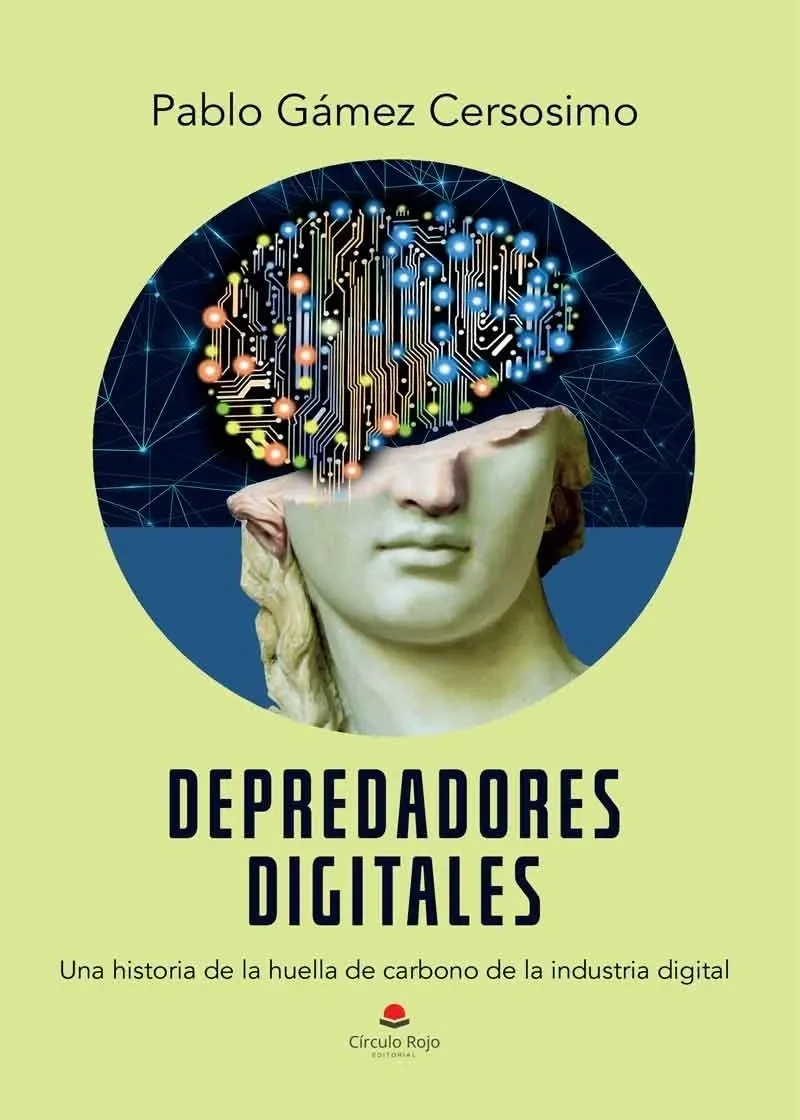
Depredadores Digitales (Círculo Rojo, 2022) is an independent, worldwide journalistic investigation into the hidden social and environmental consequences of the digital industry, the platform economy, and our everyday digital consumption habits.
Why does the social-environmental impact of digitalization matter?
The explosive growth of digitalization — accelerated by Artificial Intelligence and digital sovereignty — is driving a massive increase in carbon footprint, water footprint, and e-waste. These impacts are rarely factored into corporate or governmental digital strategies.
This omission, combined with rising digital pollution, is unsustainable. While we celebrate technological progress, we continue to externalize its heavy environmental and social costs.
How big is the problem?
Several scientific reports paint a concerning picture. Global data centers already consume hundreds of terawatt-hours of electricity annually (equivalent to the power use of entire countries), with projections showing this demand could double or triple by 2028–2030. AI systems alone could generate between 33 and 80 million tons of CO₂ in 2025 — comparable to the annual emissions of a major city like New York.
The physical infrastructure behind our digital world — mining rare minerals, semiconductor manufacturing, data centers, undersea cables, satellites, and massive e-waste streams — demands ever-growing amounts of energy and freshwater. Data centers are among the fastest-growing water users in many regions, with hyperscalers like Google and Meta reporting billions of gallons consumed yearly for cooling. Global e-waste reached 62 million tons in 2022 and continues climbing rapidly, with very low recycling rates.
We often relativize this impacts because it feels invisible. Meanwhile, digital sovereignty ranks high on national agendas, yet its intersection with energy security, resource depletion, and climate change is frequently downplayed or ignored by key industry players.
What can we do?
Addressing these externalities requires critical thinking: questioning the real necessity and usefulness of many of our digital habits, purchasing decisions, and constant upgrades.
We urgently need transparent, universal methodologies to measure and report the true footprint of digital technologies. In this context, digital sobriety — conscious reduction in unnecessary consumption, extended device lifespans, and more mindful use — emerges as a practical and powerful response.
You can get here your copy of "Depredadores Digitales"
*
You can get here your copy of "Depredadores Digitales" *

Apple
Depredadores digitales by Pablo Gámez Cersosimo on Apple Books
Amazon
https://www.amazon.com/Depredadores-digitales-historia-carbono-industria-ebook/dp/B09NCVSXH3
https://books.google.nl/books/about/Depredadores_digitales.html?id=3kNUEAAAQBAJ&redir_esc=y
Casa del Libro
https://www.casadellibro.com.co/libro-depredadores-digitales/9788411113212/12652697
https://www.bol.com/nl/nl/p/depredadores-digitales/9300000071145362/
Or you can also send me an email at: naturallydigital.org@gmail.com

In the media
Pablo Gámez, investigador: “El peso de la basura tecnológica actual supera al de la Gran Muralla China” | Diario El País (Spain)
Una mina de oro en la basura: así se salvan los metales preciosos de los aparatos desechados | Diario El País (Spain)
Green IO
It’s a 252 pages report with the foreword of António Guterres, the Secretary-General of the United Nations, talking about digitalization and sustainability. And, for once, it’s not another report from the UN stating “let’s digitize everything to boost sustainability”. Quite the contrary as it states a “unequal ecological exchange between developed and developing countries regarding digitization”. To discuss this “scientific report based on an ethical approach” as he described it, we welcome one of its contributors, Pablo José Gamez Cersosimo, based in the Netherlands. Another contributor, Paz Pena Ochoa, based in Chile, joined us to share her unique perspective on Latin America.